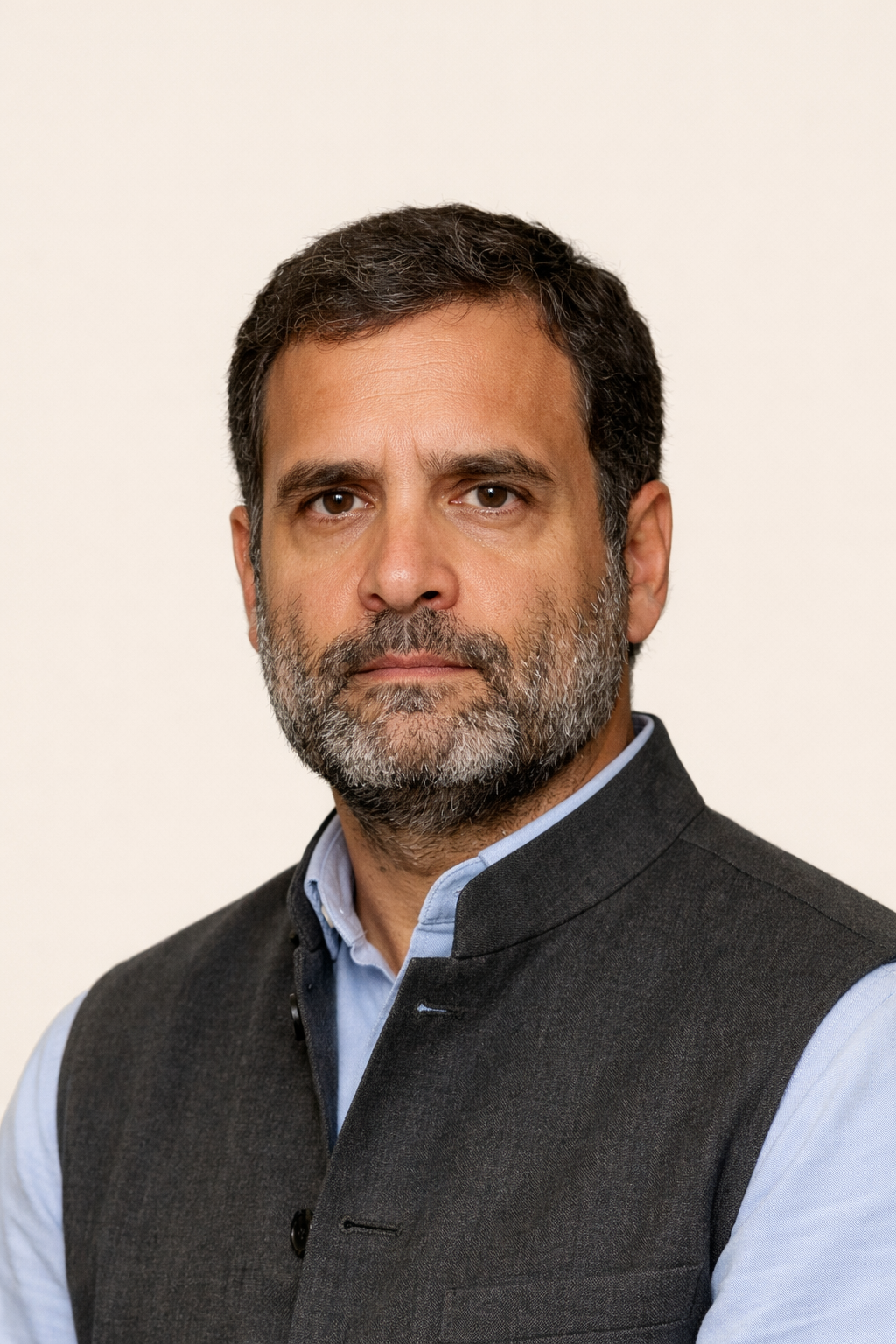
Rahul Gandhi
He leads the Opposition's campaign against Chief Election Commissioner Gyanesh Kumar over alleged mass voter deletions; police detained him mid-march on October 12 and the Supreme Court has now issued him notice over the protest.
Rahul Gandhi has made the Election Commission his central fight, leading the INDIA bloc's demand that Chief Election Commissioner Gyanesh Kumar resign over a voter-roll revision the Opposition says illegally deleted more than 130 million names to benefit the BJP. Police detained him on October 12 as he led the March for Democracy toward the Supreme Court; on October 15 the Court issued him notice, and Chief Justice Surya Kant said the bench intends to question him about how crowds entered the court's premises.
Since the Court said on October 5 that it had never approved a modified Form 6, Gandhi has declared it "established beyond doubt" that Kumar changed the form illegally, calling it a "criminal assault on our democracy." At an October 14 press conference, after meeting students injured in the crackdown, he vowed punishment for everyone from Narendra Modi, Gyanesh Kumar and Amit Shah down to "the constable who raises a hand against our children."
The counterattacks are piling up: Union Minister Piyush Goyal posed ten questions demanding proof of the vote-theft claims and alleged Gandhi misbehaved with a pregnant journalist; BJP president Nitin Nabin demanded his resignation; Assam Chief Minister Himanta Biswa Sarma offered to quit and fight a paper-ballot election if Gandhi gives up the Congress government in Kerala. Bloc ally Akhilesh Yadav skipped a strategy lunch, reportedly over Gandhi's unconsulted sit-ins, straining ties before Uttar Pradesh seat-sharing talks.
Gandhi attacked Punjab Chief Minister Bhagwant Mann's government after the October 15 murder of anti-drug activist Parvinder Singh Jhota, saying raising a voice against drugs has become a "death sentence," and called the arrest of young protesters at Jantar Mantar "an act of cowardice." His docket is busy too: a National Herald challenge with Sonia Gandhi and two defamation cases he calls "lawfare."
On their plate
Gandhi is the Opposition's point man against Chief Election Commissioner Gyanesh Kumar, demanding his resignation over the Special Intensive Revision, which the Opposition says deleted more than 130 million voter names to benefit the BJP. He calls the exercise "vote theft" and has accused the Commission of match-fixing, drawing counterattacks such as Kerala BJP president Rajeev Chandrasekhar's demand that he apologize for calling Prime Minister Modi a traitor. After the Court's October 5 clarification that it never approved a modified Form 6, he declared it "established beyond doubt" that Kumar changed the form illegally and unilaterally, vowing that everyone involved will be held accountable.
Police detained Gandhi during the crackdown as he led the INDIA bloc's March for Democracy toward the Supreme Court on October 12, protesting electoral-roll irregularities. On October 15 the Court issued notices to him, Mallikarjun Kharge and Akhilesh Yadav over the march, and Chief Justice Surya Kant said the bench intends to question Gandhi about how crowds entered the Supreme Court premises, putting his protest leadership itself under scrutiny.
Gandhi held an October 14 press conference after meeting students injured in the Delhi Police crackdown on protests against the Election Commission chief, urging students to film police misconduct as evidence. He condemned the arrest of young Jantar Mantar protesters as "an act of cowardice," saying the site "belongs to the people of India," and separately accused Amit Shah and Delhi Police of systematically silencing women, citing the assault of journalists Shaheen Khan and Nafisa Khan at Saket police station during an event Shah attended. The police focus follows his late-September call for youth and Gen Z women to protest sexual violence after the alleged gang rape of a 17-year-old in south Delhi.
After anti-drug activist Parvinder Singh Jhota was murdered on October 15, triggering a statewide bandh, Gandhi attacked Punjab's AAP government and Chief Minister Bhagwant Mann for failing to protect campaigners. He said raising a voice against drugs has become a "death sentence" and asked why drug peddlers would fear police when the complainant becomes the accused.
Gandhi and Sonia Gandhi petitioned the Delhi High Court to quash the Enforcement Directorate's National Herald money-laundering case, arguing the agency proceeded from a private complaint rather than an FIR after a seven-year gap and calling its rapid appeal of a favorable trial-court ruling an abuse of process. Courts have also upheld defamation summons over his 2018 "commander-in-thief" remark on the Rafale deal and refused to fast-track a case over his 2022 claim that Chinese soldiers beat Indian Army personnel in Arunachal Pradesh. He brands the cases "lawfare" meant to muzzle the Opposition.
Key relationships
Gandhi has made the Chief Election Commissioner his chief target, demanding his resignation and accusing him of illegally altering Form 6 to benefit the BJP.
Gandhi accuses the Home Minister of presiding over a police apparatus that silences women and brutalizes protesters, and has promised he will face punishment.
The Chief Justice heads the bench now scrutinizing how Gandhi's protest reached the Supreme Court's own premises.
Gandhi has trained his ultimate accountability threat on the Prime Minister as the voter-roll dispute deepens.
The Union Minister is pressing Gandhi to substantiate his voter-fraud claims and has raised a personal misconduct allegation against him.
The BJP national president wants Gandhi out over the protest campaign against the Election Commission.
Gandhi has turned on the Punjab Chief Minister over the murder of an anti-drug activist, attacking his government's record of protecting campaigners.
A fellow INDIA bloc leader whose coordination with Gandhi has frayed ahead of the Uttar Pradesh assembly elections and seat-sharing talks.
The Assam Chief Minister is daring Gandhi to stake his own party's government to prove his mistrust of the Election Commission.
The two have mounted a joint legal defense in the Enforcement Directorate's National Herald money-laundering case.
