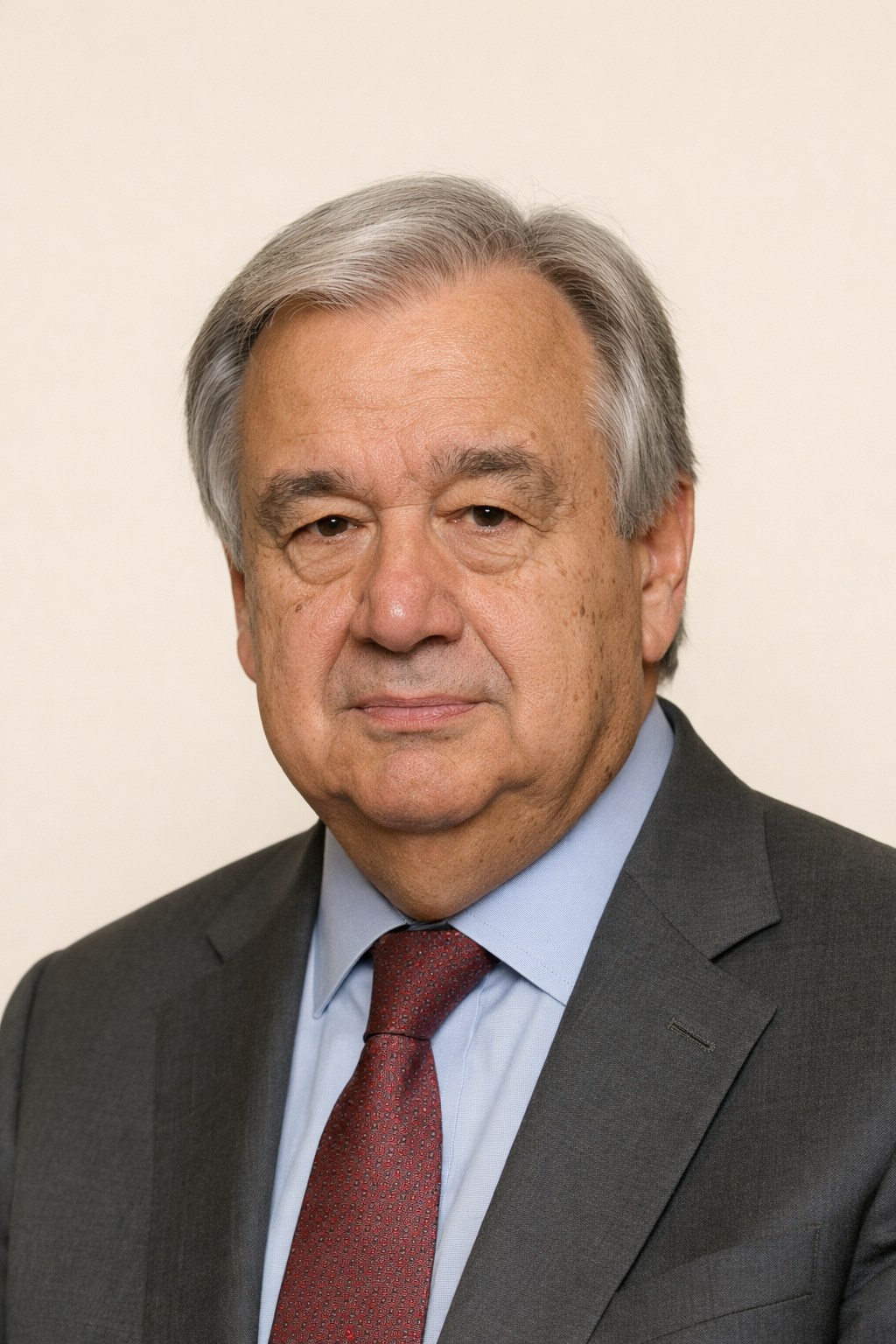
António Guterres
Condemned the Houthi strike that killed 12 at Riyadh's airport, demanded a permanent Gaza ceasefire as war spreads across the region, and urged Ethiopia back toward dialogue.
António Guterres is pressing international law against a widening regional war. He condemned the Houthi missile attack that killed 12 at Riyadh's King Khalid International Airport on October 10, calling attacks on civilians and civilian infrastructure a violation of international law. With the Gaza war spanning Iran, Lebanon, Syria and Yemen, he has described Israel's response as collective punishment, and from Islamabad he called for ending the US-Iran war and restoring navigation through the Strait of Hormuz.
Marking three years since October 7, he demanded a permanent Gaza ceasefire, humanitarian assistance at scale and respect for international law, citing a Palestinian Health Ministry toll of more than 74,200 deaths. He warned that settler attacks across the central West Bank, which UN OCHA says have reached 275 communities this year, pose an existential threat to Palestinians, and he still calls two independent states the only credible path to security. He met Qatar's Amir to discuss de-escalation, and after renewed fighting in Ethiopia's Tigray, Afar and Amhara regions he urged Pretoria Agreement signatories back to dialogue, offering his good offices.
He secured the General Assembly's first declaration on sea-level rise, warning that countries and cultures must not vanish beneath the waves, and pressed a revolution in finance to match what he calls unstoppable clean energy while backing Anthony Albanese's case for emissions cuts. He launched a UNDP-led mechanism helping six countries move up critical-minerals value chains.
He closed his final high-level General Assembly warning that deep divisions limit the UN's ability to resolve conflicts, and is pushing Security Council reform, a multilateral AI framework, a ban on killer robots and neurotechnology guardrails classifying thoughts as sensitive personal data. He continues to block Myanmar's junta from unseating the elected government's UN envoy, and channeled a pandemic-prevention appeal through his deputy, Amina Mohammed.
On their plate
He condemned the Houthi missile attack on Riyadh's King Khalid International Airport that killed 12 people and injured hundreds on October 10, calling attacks on civilians and civilian infrastructure a violation of international law. With the Gaza war expanded into a regional conflict spanning Iran, Lebanon, Syria and Yemen, he has characterized Israel's response as collective punishment. From Islamabad he demanded an end to the US-Iran war and full restoration of navigational rights and freedoms in the Strait of Hormuz in accordance with international law.
Marking three years since October 7, he demanded a permanent ceasefire, humanitarian assistance at scale and respect for international law, countering Israel's security-recovery narrative with a Palestinian Health Ministry toll of more than 74,200 deaths. He warned that settler attacks across the central West Bank, which UN OCHA says have affected 275 communities so far this year, pose an existential threat to Palestinian communities. He calls two independent, sovereign, democratic states the only credible path to regional security.
After renewed fighting in the Tigray, Afar and Amhara regions, he urged the Pretoria Agreement's signatories to return to dialogue, invoking states' Charter obligations against interference and the use of force. He has offered his good offices to help resolve the conflict.
He secured the General Assembly's first declaration on sea-level rise, warning that countries and cultures cannot be allowed to vanish beneath the waves, with the declaration affirming that statehood and maritime boundaries survive receding coastlines. He is urging a revolution in finance to match a clean-energy transition he says has gone from alternative to unstoppable, and has demanded tripled climate adaptation funding for developing nations while criticizing continued fossil-fuel expansion as defying both science and economics. He launched a UNDP-led mechanism to help Indonesia, Zambia, Guinea, Zimbabwe, Madagascar and Nigeria move up copper, cobalt, lithium, nickel and bauxite value chains instead of remaining raw-material exporters, and has linked the Bhote Kosi-Trisuli flood that killed more than 8,000 people in Nepal and China to climate breakdown.
He demands Security Council reform, calling the lack of permanent African representation unjust and indefensible, and closed his final high-level General Assembly session warning that deep international divisions limit the UN's ability to resolve global conflicts. He is pressing for a multilateral AI framework with equal representation for developing nations, framing AI and climate as chapters of the same story, the story of power. At that General Assembly, President Donald Trump dismissed AI-risk warnings as a conspiracy while Guterres urged coordinated international governance of the technology. He wants killer robots banned, saying they must have no place in our future, and has published a report warning that neurotechnologies could let governments extract information from human brains and predict crimes in justice systems, recommending that thoughts be classified as highly sensitive personal data requiring explicit consent in criminal justice.
Key relationships
Blocks the Myanmar junta's petitions to remove him, leaving the envoy's UN recognition resting on Guterres's decisions even as Kyaw Moe Tun runs the mission without salary or funding.
Backed the Australian prime minister's economic case for emissions cuts at the UN Climate Summit sidelines, calling clean energy unstoppable and urging a revolution in finance to match the energy revolution.
