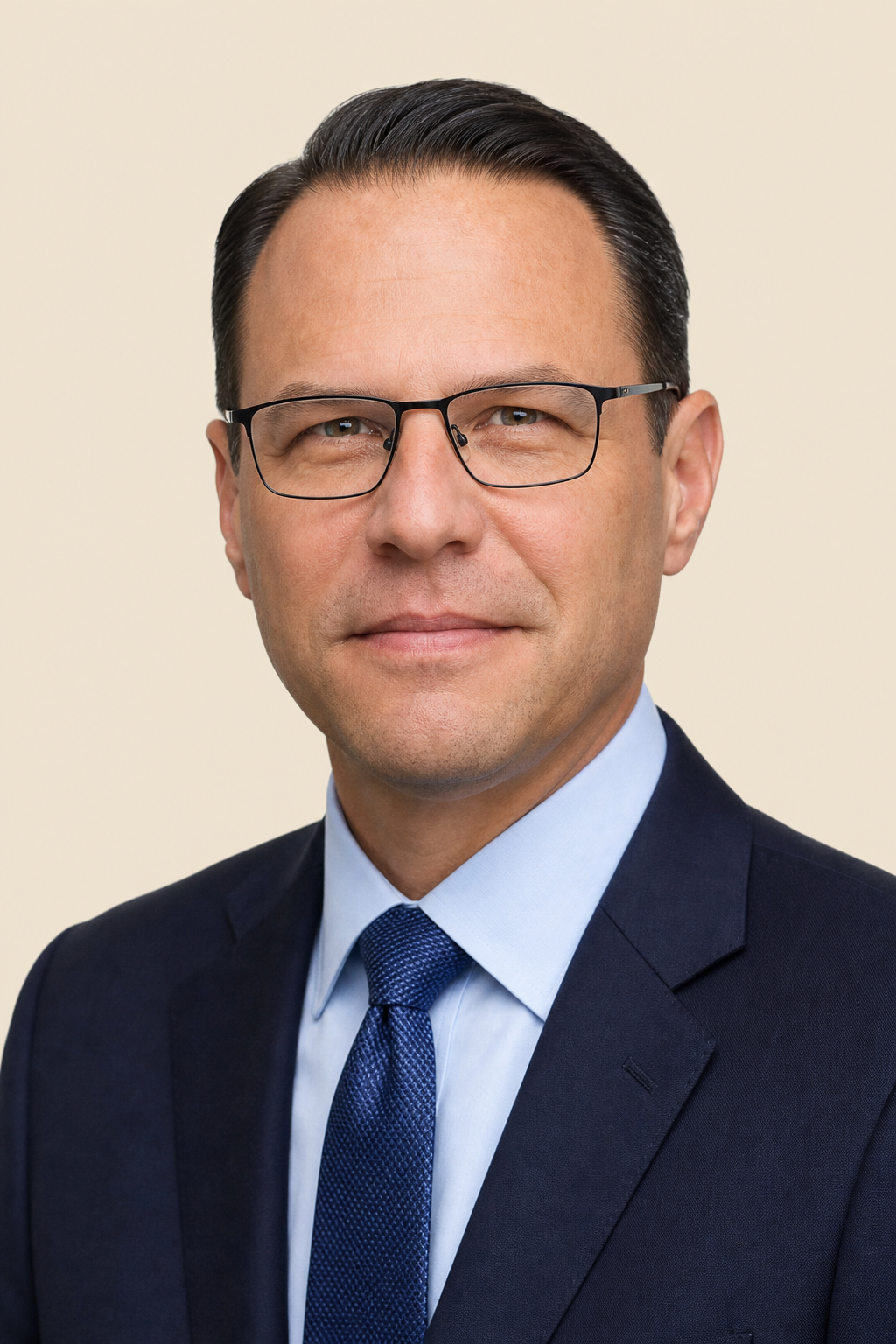
Josh Shapiro
Leads his reelection race by more than 20 points with a 38-to-1 cash edge, restricts data centers by executive order, and presses for federal AI guardrails, a playbook Midwestern Democrats now copy.
Josh Shapiro, Pennsylvania's governor, heads into the fall with a more than 20-point lead over Republican Stacy Garrity, a 38-to-1 cash edge as of June, and a persuasion campaign holding 58 percent of independents and 31 percent of Republicans. Observers read the race as a blueprint test for 2028, and Midwestern Democrats are already copying his pragmatic, bipartisan playbook for their own campaigns. He agreed to a single debate with Garrity on October 7, Pennsylvania's first gubernatorial debate since 2018, expected to cover data center regulation, the measles outbreak response, and Trump, who has endorsed Garrity.
In Pittsburgh on September 17 he called for muscular federal AI regulation and tougher public safeguards, saying it is "long past time" for Washington to set guardrails at home and abroad, though he does not believe an AI takeover or misuse is inevitable. He dismissed as wrong Trump's characterization of public AI concerns as a "hoax," and faulted Trump and Speaker Mike Johnson for an insufficient response to rogue AI.
His executive order requires data center developers to bring their own power to qualify for streamlined permitting, his answer to state regulators' warning that the regional grid could fail reliability standards between 2027 and 2030, and it bars state agencies from signing NDAs with developers. The state House has passed a six-month moratorium alongside it. The gas industry's Marcellus Shale Coalition calls the restrictions "the wrong message" on economic opportunity.
He lured Burlington Stores' headquarters to Philadelphia with $30 million in state grants, a $370 million move bringing at least 2,000 jobs. He is pulling Flock license-plate cameras from the state contracting portal and would welcome a bipartisan statewide ban, over Franklin County Chief Deputy Dan Foy's objections. Black pastors are pressing him to join a federal tax-credit scholarship program; he has yet to act.
On their plate
In a September 17 Pittsburgh speech he called for muscular federal AI regulation and tougher public safeguards, saying it is "long past time" for Washington to establish AI guardrails domestically and on the global stage. He said he does not believe AI taking over the world or being misused is inevitable. The push sets him directly against Trump's pro-data-center, anti-regulation stance.
His executive order requires data center developers to provide their own power sources to qualify for streamlined permitting, a response to state regulators' warnings that the PJM regional grid could fail reliability standards between 2027 and 2030. It also bars state agencies from signing NDAs with developers and adds transparency requirements and local veto power over new projects, and the state House has passed a six-month moratorium alongside it. The Marcellus Shale Coalition's Jim Welty says the restrictions send "the wrong message" on economic opportunity and threaten gas producers' best hope for in-basin demand after nine of Pennsylvania's last ten major pipeline projects were cancelled or withdrawn.
He leads Garrity by more than 20 points, holding 58 percent of independents and 31 percent of Republicans with a persuasion-focused moderation strategy, and holds a 38-to-1 cash-on-hand lead as of June. He agreed to a single televised debate with Garrity on October 7 at 8 p.m. on ABC 27 in Harrisburg, Pennsylvania's first gubernatorial debate since 2018, moderated by Dennis Owens. It is expected to cover data center regulation, the measles outbreak response, and Trump, who has endorsed Garrity.
He said "Flock cameras are not a tool that I support," announced he would welcome bipartisan legislation to ban them statewide, and is pulling Flock Safety from the COSTARS state contracting portal while working with legislators on at least nine restriction bills. The cameras are already prohibited on state property and PennDOT roadways, and the State Police does not use them. Republican Senator Dan Laughlin, who proposed an outright ban, is working with him on the legislation, while Franklin County Chief Deputy Dan Foy argues the removals would hinder law enforcement's ability to quickly apprehend violent criminals.
Political observers view his reelection bid as a demonstration of electoral viability in a battleground state ahead of the most wide-open Democratic presidential primary since 2008, and he tells audiences "I don't know about you, but I'm done with chaos." Midwestern Democratic candidates are copying his pragmatic, bipartisan playbook for their own 2026 races. His campaign's moderation strategy is framed as a blueprint test for the party ahead of 2028.
Key relationships
Shapiro is building a national profile against the president's AI stance, dismissing Trump's "hoax" framing of public concerns and pushing regulation Trump opposes.
His Republican challenger, endorsed by Trump, trails him by more than 20 points; they meet once in an October 7 debate.
The Philadelphia mayor partnered with him to land Burlington Stores' headquarters, adding a $7 million forgivable loan and job-creation tax credits to his $30 million in state grants.
The gas industry coalition president says Shapiro's data center restrictions send "the wrong message" on economic opportunity and threaten producers' best hope for in-basin demand.
The House Speaker shares Shapiro's blame for Washington's insufficient response to rogue AI.
A Republican state senator partnering with the Democratic governor on privacy legislation; Laughlin has proposed an outright Flock camera ban.
The Burlington Stores CEO worked with Shapiro on relocating the retailer's headquarters to Philadelphia.
Keep reading in the app
Where they stand, in full, free in the app.
 Coming soonGoogle Play