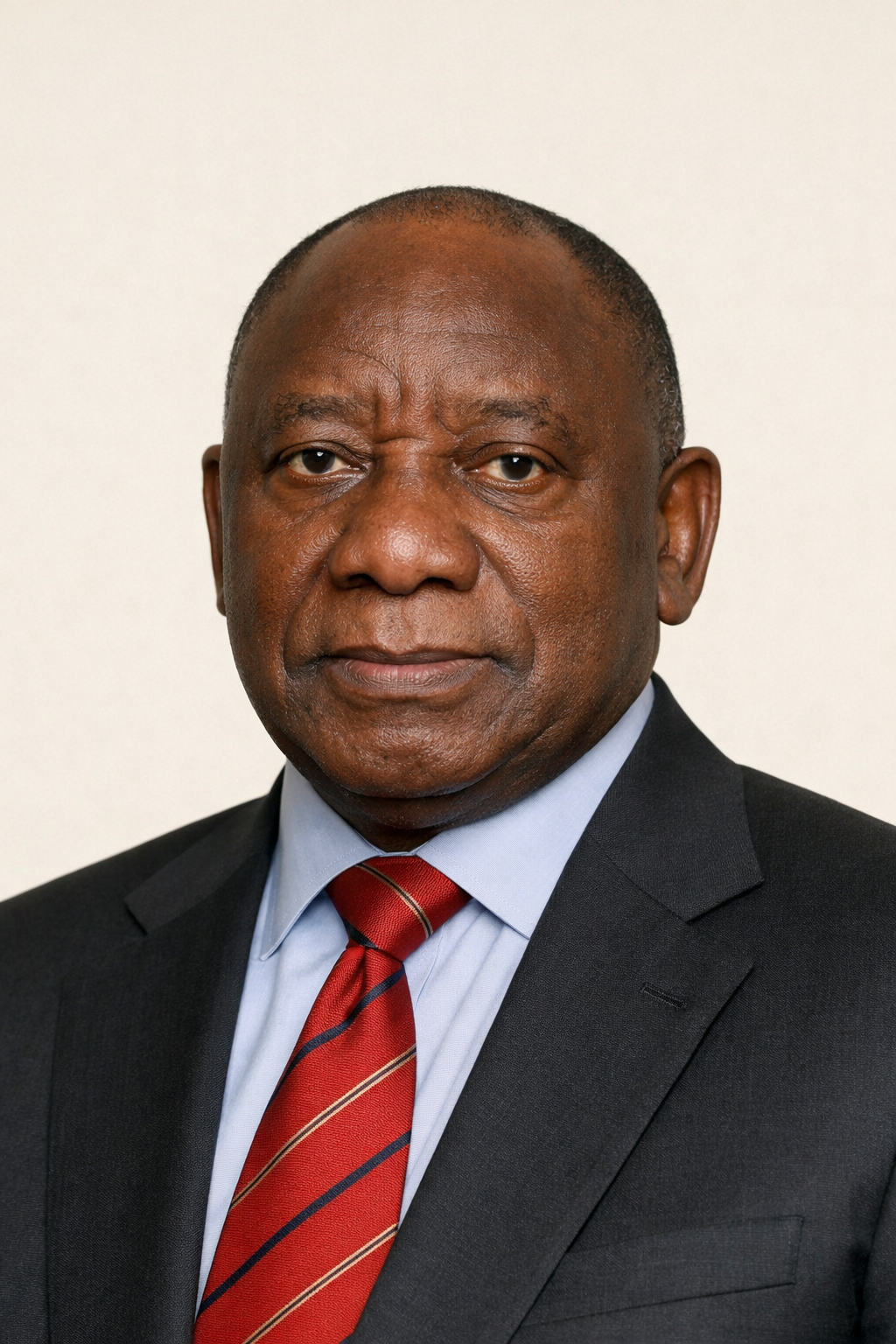
Cyril Ramaphosa
He rejected the allegations behind US visa restrictions on South African officials and urged BRICS toward local-currency trade despite Trump's tariff threat, as his grid-split mandate stalls at home.
Cyril Ramaphosa is fending off Washington on two fronts: he rejects the race-based discrimination and land-seizure allegations behind Secretary of State Marco Rubio's visa restrictions on South African officials, and he is urging BRICS toward local-currency trade despite Trump's threat of 100% tariffs if it drops the dollar.
The pressure is speeding his hunt for other markets: zero-tariff cherry access in China, new citrus treatment options in India, meat openings in Egypt, ASEAN pacts in pursuit. He carried the pitch to the 18th BRICS Leaders' Summit in New Delhi.
At home, the fight stalling on him is the grid. He is holding to a fully independent transmission operator by end-2027, with the Development Bank of Southern Africa seeking transaction advisers for the 440-billion-rand overhaul. Eskom chairman Mteto Nyati warns the unbundling strips a division worth about 37% of the utility's revenue and risks 840 billion rand in bondholder exposure; Ramaphosa insists it creates competition and addresses nearly 300 billion rand in legacy debt, not a selloff.
As the new SADC chairman, he has pledged regional integration and critical-minerals beneficiation while voicing shame at anti-migrant violence that killed at least four migrants and pushed up to 176,000 foreign nationals out of the country. He told Parliament investigators are pursuing external actors he says are instigating the violence.
With the economy contracting 0.2% in the second quarter, Busi Mavuso of Business Leadership SA wants his Operation Vulindlela reforms locked into law before the 2027 ANC leadership transition. His government-business partnership targets one million jobs by 2030, alongside a 1.67-trillion-rand infrastructure pipeline. His impeachment fight advanced: the Section 89 committee voted 18-9 to rescind evidence leader Thandazani Madonsela, whom he called biased, and he wants the Western Cape High Court to set aside the 2022 report behind the $580,000 game-farm inquiry.
On their plate
Secretary of State Marco Rubio imposed visa restrictions on South African officials over alleged race-based discrimination and land seizures, and Ambassador L. Brent Bozell III warns the restrictions are only the first step in escalatory measures meant to force Ramaphosa to roll back land laws and exempt American companies from Black ownership requirements. Ramaphosa rejects the allegations, saying there is no evidence of persecution against white people.
Ramaphosa urged BRICS to press ahead with local-currency trade and stronger cross-border payment systems, defying Trump's threat of 100% tariffs on the bloc if it replaces the dollar, and carries the push for expanded intra-BRICS trade, investment and industrialization to the 18th BRICS Leaders' Summit in New Delhi. He is diversifying away from the US after Trump's 30% tariff on South African exports, securing zero-tariff cherry access in China, new citrus treatment options in India and meat openings in Egypt, pursuing ASEAN pacts, and coordinating with Canadian leaders in Johannesburg against US trade volatility. Foreign Minister Ronald Lamola is following through his March state visit to Brazil at the Joint Commission, which Business Leadership SA's Busi Mavuso branded a political gesture carrying a 27.3-billion-rand import imbalance.
Ramaphosa is driving a fully independent transmission system operator by end-2027, with the Development Bank of Southern Africa seeking transaction advisers for the 440-billion-rand grid overhaul and barred from re-evaluating the decision to strip Eskom of its transmission assets. Eskom chairman Mteto Nyati warns the unbundling removes a division worth about 37% of the utility's revenue and risks 840 billion rand in bondholder exposure. Ramaphosa defends the split into generation, transmission and distribution entities as creating competition and addressing nearly 300 billion rand in legacy debt, not privatization, standing with Electricity Minister Kgosientsho Ramokgopa against union complaints that workers were not consulted.
Ramaphosa told Parliament the government is investigating external actors he says are instigating anti-migrant violence to destabilize South Africa, vowing arrests and rule-of-law handling of migration rather than unlawful action targeting foreign nationals. He clashed with EFF leader Julius Malema in the National Assembly over Malema's accusation that prosecutions of instigators are too slow, and rejected the charge that the unrest damaged South Africa's continental standing. He assumed the SADC chairmanship at the Durban summit, taking the post from Zimbabwe's Emmerson Mnangagwa and pledging regional economic integration, industrialization and beneficiation of critical minerals, while expressing shame at violence that killed at least four migrants and drove up to 176,000 foreign nationals out of South Africa.
Ramaphosa launched Phase 3 of the Government-Business Partnership for Growth and Jobs in Sandton, targeting above 3 percent GDP growth and one million new jobs by 2030, and warned against confusing 455 days without load-shedding with completed energy reform. His Strategic Integrated Projects portfolio has grown five-fold since 2020 to 1.67 trillion rand across more than 170 energy, water, transport and municipal projects, with 264 billion rand entering procurement in the next 12 to 18 months, and he is promoting a data-center boom that civil rights groups want halted over non-disclosure of water, land and power use. The economy contracted 0.2% in the second quarter, and Business Leadership SA CEO Busi Mavuso is pressing him to lock his Operation Vulindlela reforms into law before the 2027 ANC leadership transition.
The Section 89 committee voted 18-9 to rescind Thandazani Madonsela as evidence leader after Ramaphosa argued she was biased. He is separately asking the Western Cape High Court to set aside the 2022 Ngcobo panel report underpinning the inquiry into the $580,000 stolen from his game farm.
Key relationships
Threatened 100% tariffs on BRICS if the bloc replaces the dollar; Ramaphosa answered by urging the bloc to press ahead with local-currency trade.
The US ambassador is warning the visa restrictions are only the first step in escalatory measures meant to force Ramaphosa to roll back land laws and exempt American companies from Black ownership requirements.
The US secretary of state imposed visa restrictions on South African officials over alleged race-based discrimination and land seizures; Ramaphosa rejects the allegations as unsupported.
His foreign minister is following through his March state visit to Brazil at the eighth South Africa-Brazil Joint Commission.
The Business Leadership SA CEO is pressing him to lock Operation Vulindlela reforms into law before the 2027 ANC leadership transition, and has criticized the Brazil trade pact as a political gesture.
The EFF leader clashed with him in the National Assembly, accusing the government of slow prosecution of instigators of anti-migrant violence and jeering that some had even met the president.
The Zimbabwean president handed him the SADC chairmanship at the Durban summit; Zimbabwe and Mozambique resisted South Africa's push to make migration a standalone heads-of-state agenda item.
The Business Leadership South Africa chair co-convened the Phase 3 growth partnership launch and backed it while insisting growth must exceed 3 percent to create net jobs.
The electricity minister defended the Eskom unbundling alongside Ramaphosa and is pressing to lift Public Finance Management Act constraints so Eskom can compete with independent power producers.
The Canadian prime minister whose government Ramaphosa is dealing with directly to hedge against US trade hostility, with the two countries' government and business leaders meeting in Johannesburg to coordinate strategies.
