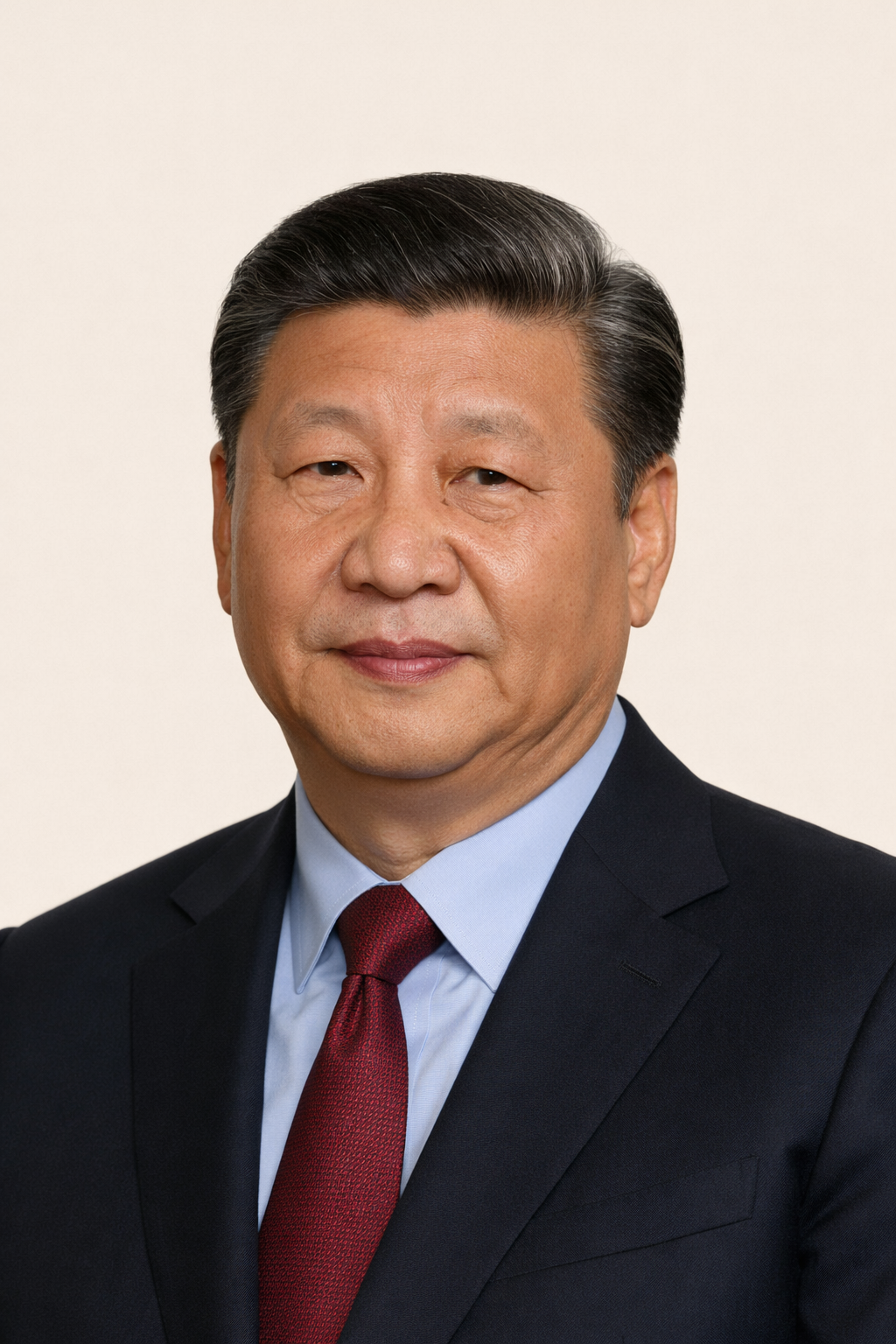
Xi Jinping
Hosts Donald Trump in Shenzhen November 17-19, their third meeting of 2026; Trump says he has spoken with him directly about newly initiated denuclearization talks. This week he proposed a four-principle framework for resolving African conflicts and elevated ties with Togo.
Xi Jinping has a new front with Washington: nuclear arms control. Donald Trump says the United States is talking denuclearization with both Russia and China and has spoken directly with Xi, voicing concern that China's arsenal could catch up to America's within five years. Xi hosts Trump in Shenzhen November 17-19, their third meeting of 2026, with the trade truce extended to January 10, 2027. Taiwan, rare earths and chip export controls remain unresolved, and China's central bank approved Visa's bankcard-clearing application, a goodwill gesture analysts read as pre-summit positioning.
Africa filled his week. At an October 15 Beijing meeting he proposed four principles for resolving African conflicts, an 'Africa-led' framework pairing ceasefire diplomacy with infrastructure and industrialization investment, and with Togo's Faure Gnassingbé announced elevated ties, pushing zero-tariff access, green lanes and renminbi settlement as bilateral trade grew 55 percent to $5.4 billion in 2025. Botswana's President Duma Gideon Boko is visiting through October 17, and a congratulatory letter to the 140th Canton Fair cast China as defender of the multilateral trading system.
Taiwan remains the sharpest edge. His government branded Lai Ching-te a secessionist threat after Lai's October 10 National Day speech announcing a record NT$1.1 trillion 2027 defense budget, and 21 military aircraft and seven navy ships operated around the island within 24 hours. A stalled major U.S. arms sale is being held as leverage in the Trump relationship; a senior U.S. official calls Xi a rational actor deterred from seizing Taiwan by 2027.
At home the superpower push runs on debt above 300 percent of GDP, up more than $43 trillion since 2012. He set 2030 health targets, warned against wholesale marketization of medicine, and marked the Long March anniversary in Yudu. Journalist Andrew Higgins's six-month reporting describes an AI-powered surveillance state demanding 'unswerving loyalty.'
On their plate
A new front after New START's expiry: Donald Trump says the United States is talking denuclearization with both Russia and China, and that he has spoken directly with Xi about it. Trump has voiced concern that China's nuclear arsenal could catch up to America's within five years.
Xi will host Donald Trump in Shenzhen November 17-19, their third meeting of 2026, with an AI alert system running and the trade truce extended to January 10, 2027. Taiwan, rare earths and chip export controls remain unresolved. China's central bank has approved Visa's domestic bankcard-clearing application, a goodwill gesture tied to the leaders' engagements that analysts read as pre-positioning ahead of the summit.
After Lai Ching-te's October 10 National Day speech announcing Taiwan's record NT$1.1 trillion defense budget for 2027, Xi's government branded Lai a secessionist threat and kept 21 military aircraft and seven navy ships operating around the island within 24 hours. A stalled major U.S. arms sale to Taiwan is being held as leverage within the Trump-Xi relationship, even as Washington delivers two F-16 consignments and opens a new Arizona representative office. A senior U.S. official says Washington reads Xi as a rational actor deterred from seizing Taiwan by 2027, though the latest Trump-Xi summit ended without a public agreement on Taiwan.
Xi proposed four principles for resolving African conflicts at an October 15 Beijing meeting, an 'Africa-led' framework pairing ceasefire diplomacy with long-term infrastructure and industrialization investment, presented to Togo's Faure Gnassingbé. With Gnassingbé he announced the elevation of China-Togo ties to a 'community with a shared future for the new era,' pushing zero-tariff export access, green lanes and renminbi settlement as bilateral trade grew 55 percent to $5.4 billion in 2025. He is hosting Botswana's President Duma Gideon Boko on a state visit through October 17, Boko's first since taking office, and sent a congratulatory letter to the 140th Canton Fair casting China as defender of the multilateral trading system and stable supply chains.
He is funding military and core-technology superpower ambitions on a debt surge: nonfinancial-sector credit above 300 percent of GDP, up more than $43 trillion since 2012, with the IMF pegging government debt at 127 percent of GDP, and he has not taken the pivot from fixed-asset investment to household consumption that economists urge. He opened the 15th Five-Year Plan period with 2030 health targets, among them life expectancy of 80 years, community-level care and biomedicine as a pillar industry, drawing a line against wholesale marketization of the medical sector; at Yudu County, Jiangxi, he marked the Long March's 92nd anniversary, framing today as a 'new journey' to build a modern socialist country. Andrew Higgins's six-month reporting describes an AI-powered surveillance state demanding 'unswerving loyalty' to the party, with dissent suppressed.
Key relationships
A managed rivalry heading into a third meeting of 2026: Xi hosts Trump in Shenzhen November 17-19 with the trade truce extended to January 10, 2027, though Taiwan, rare earths and chip export controls remain unresolved. Trump says he has spoken directly with Xi about newly initiated denuclearization talks with Russia and China.
Xi met Togo's President of the Council of Ministers in Beijing on October 15, presenting his four principles for resolving African conflicts and announcing the elevation of bilateral ties to a 'China-Togo community with a shared future for the new era,' with zero-tariff export access, green lanes and renminbi settlement on the table as trade grew 55 percent to $5.4 billion in 2025.
Xi met the Indian prime minister at a recent BRICS summit to address India's record $105.93 billion trade deficit with China, plus market access and rare-earth export-control concerns. The September 12 meeting anchors India's effort to rebuild diplomatic and economic ties with China, though New Delhi says the terms must stay fair and the geopolitical situation stable.
