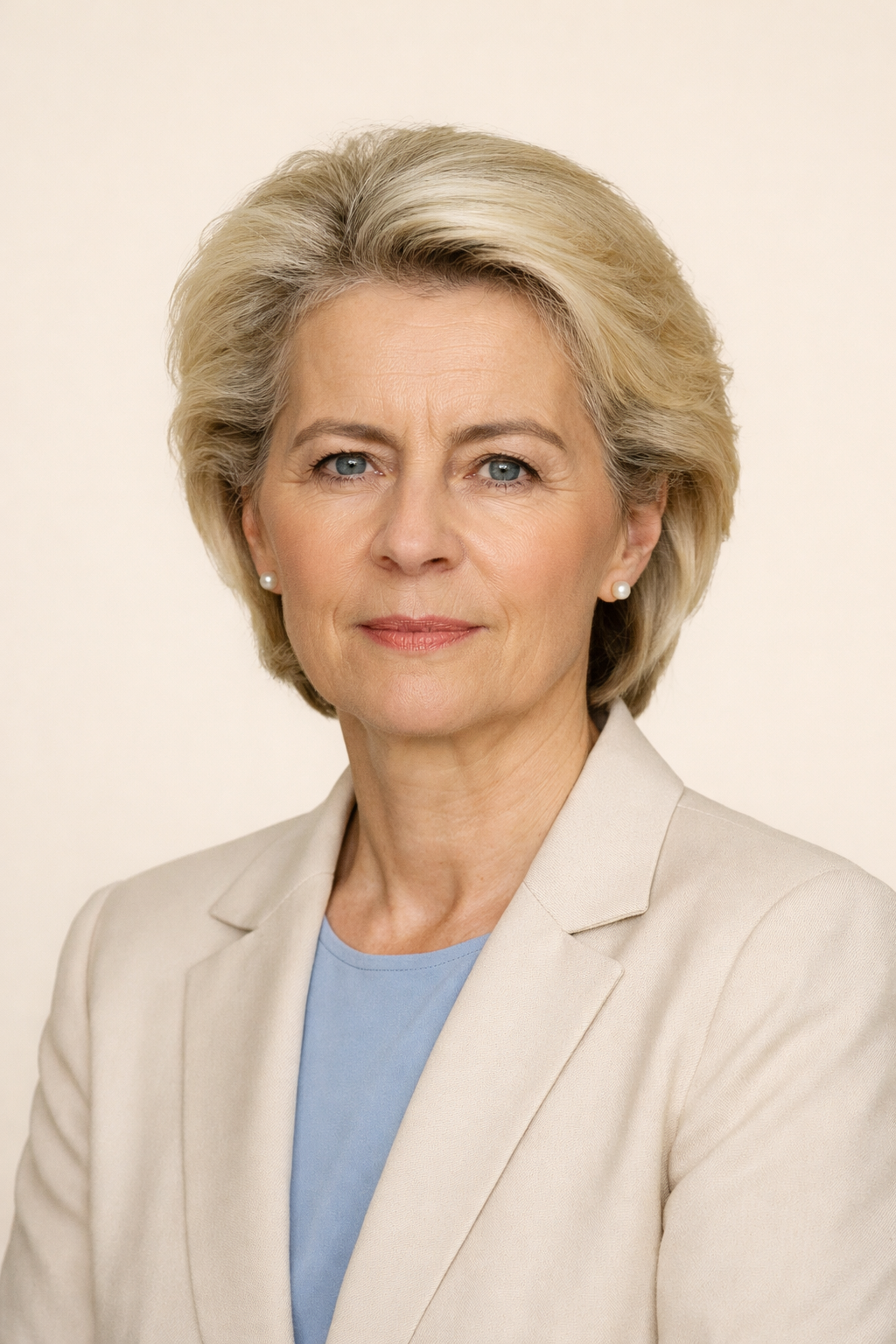
Ursula von der Leyen
She shelved the EU digital levy after US pressure and swapped in a flat charge on large firms to fund her two-trillion-euro budget, while readying a 22nd Russia sanctions package as Washington waives its own.
Ursula von der Leyen is defending a two-trillion-euro 2028–2034 EU budget, a 60 percent spending increase funded by levies, against a German-led frugal bloc and a Court of Auditors debt warning. Under pressure from US President Donald Trump, her Commission abandoned its planned digital levy, replacing it with a flat annual charge on EU firms with over 100 million euros in revenues to refinance 800 billion euros in EU bonds in 2028.
She disbursed 1.24 billion euros to Ukraine on October 7 for Ukrainian-made drones and missiles from a 90-billion-euro support loan, saying Russia is “continuing its deliberate strategy of terror.” As Trump waived US sanctions on Russia's energy, defense and financial sectors, she announced plans for a 22nd sanctions package after the EU approved its largest expansion since the war began. She rejected the US plan, presented by envoys Steve Witkoff and Jared Kushner, for moving 210 billion euros in frozen Russian assets under Washington's control, insisting “Moscow must pay for the destruction it has caused.”
During her Balkans visit she countered Prime Minister Albin Kurti over the Hague verdicts on KLA commanders, adding “nothing and nobody can rewrite Kosovo's history.” Her Commission faces a legal challenge for withdrawing funding from the European Network Against Racism, part of a broader backlash over perceived EU double standards on Muslim civil rights that extends to her framing of Gaza as a humanitarian emergency rather than a genocide.
Facing the bloc's second energy price crisis in under five years, she is appointing an operator for joint EU energy purchases and delayed methane rules for importers by a year. At the Dublin AI summit she promoted billions for gigafactories and data centers, saying “we need to stay in the race,” and she is pushing to sign the EU-India trade deal by end-2026.
On their plate
She is defending a 2028–2034 EU budget that raises spending 60 percent, funded by levies on tobacco, the environment and large companies, and has cautioned the European Parliament that large cuts "would risk cutting deep into critical priorities" and "we have to do the hard work on the revenue side." Under Trump's pressure she abandoned the planned digital levy on large platforms, replacing it with a flat annual levy of 100,000 to 750,000 euros, set by revenue class, on EU companies with more than 100 million euros in net revenues, to finance the budget and the 2028 refinancing of 800 billion euros in EU bonds. The plan faces a German-led frugal bloc of six, a Court of Auditors warning that EU debt could reach one trillion euros by 2027 and a summit deadlock, plus a vow from Marine Le Pen to cut France's net contributions to five billion euros and curb Ukraine funding if she wins France's April–May presidential election.
She disbursed 1.24 billion euros to Ukraine on October 7 for drones, drone interceptors and missiles produced by Ukrainian entities, part of a 90-billion-euro support loan split between defense and budget support, and she called the Russian drone strikes that sank three commercial ships in the Black Sea, killing at least two crew members, unacceptable attacks on civilian shipping. As Trump waived sweeping US sanctions on Russia's energy, defense and financial sectors, she announced plans for a 22nd EU sanctions package after the bloc approved its largest expansion of Russia sanctions since the war began. She rejected the US plan, presented by envoys Steve Witkoff and Jared Kushner, to move the 210 billion euros in frozen Russian state assets into a Washington-controlled vehicle, holding that "Moscow must pay for the destruction it has caused."
At the Dublin AI summit she promoted the Apply AI strategy, pledging billions of euros for AI gigafactories and expanded data-center capacity against the US and China, telling the gathering "we need to stay in the race. Because this is crucial for our independence," alongside her tech chief Henna Virkkunen. In her September 16 State of the Union address she committed to overhauling single-market rules by the end of 2027, advancing the EU Inc package to ease cross-border expansion, in response to founders' frustration over energy costs and regulatory fragmentation. Analyst Andrea Renda of CEPS has warned the strategy lacks a dedicated budget and sufficient political leadership.
She and Prime Minister Narendra Modi are pushing to finalize the EU-India Free Trade Agreement by the end of 2026, a deal they jointly announced on January 27 and describe as the largest Europe has ever concluded, with ratification and implementation expected in 2027. On China she received a joint letter from President Emmanuel Macron and Chancellor Friedrich Merz urging her to implement a new trade diversification instrument and strengthened trade defense measures; Beijing publicly warned against it as protectionism that "cannot enhance competitiveness," and German business leaders cautioned against kill-switch rhetoric and escalating retaliation. She has also announced a goal to mobilize up to 12 billion euros in public and private investment for regional logistics via the Middle Corridor, tying the Caucasus to EU integration even as NATO's partnership plans for Armenia and Azerbaijan stall in a France-Turkey deadlock.
With the bloc managing its second energy price crisis in less than five years, she announced the EU will appoint a market operator to manage joint energy purchases, broadening the post-invasion gas pooling system to other energy sources. She delayed methane emission reporting rules for oil and gas importers by one year, moving compliance from January 2027, to ease fuel costs. The delay came alongside a G7 agreement to release 100 million barrels of diesel and crude and a new Commission dialogue with European refineries.
Key relationships
She abandoned the EU's planned digital levy under direct pressure from Trump and met him in July 2025 on regulation, a session that produced a joint statement suggesting the US poses negligible deforestation risk, yet she rejected the US plan, presented by envoys Steve Witkoff and Jared Kushner, for taking the 210 billion euros in frozen Russian assets into a Washington-controlled vehicle.
The German chancellor co-signed a letter with President Emmanuel Macron urging her to implement a new trade diversification instrument and strengthened trade defense measures, and he is working to rein in her two-trillion-euro budget expansion, while his insistence that the frozen Russian assets are European business and must stay in Europe runs parallel to her rejection of the US plan.
The French president co-signed a letter with Chancellor Friedrich Merz urging her to implement a new trade diversification instrument and strengthened trade defense measures on China.
Le Pen traveled to Brussels to vow she will slash France's net EU contributions to five billion euros and curtail Ukraine funding if she wins the April–May French presidential election, a spending showdown aimed at the two-trillion-euro budget and Ukraine-aid plans von der Leyen is defending.
She is fronting the Apply AI push with her tech chief Virkkunen; the two jointly promoted AI adoption for industrial competitiveness at the Dublin AI summit.
She and the Indian prime minister are pushing to finalize the EU-India Free Trade Agreement by the end of 2026, a deal they jointly announced on January 27 and describe as the largest Europe has ever concluded.
Visiting the region after the Hague convicted Hashim Thaçi and three KLA commanders, von der Leyen publicly countered Kosovo's prime minister, insisting the rulings "were delivered by independent judicial institutions, and their mandate must be fully respected" and that "nothing and nobody can rewrite Kosovo's history."
