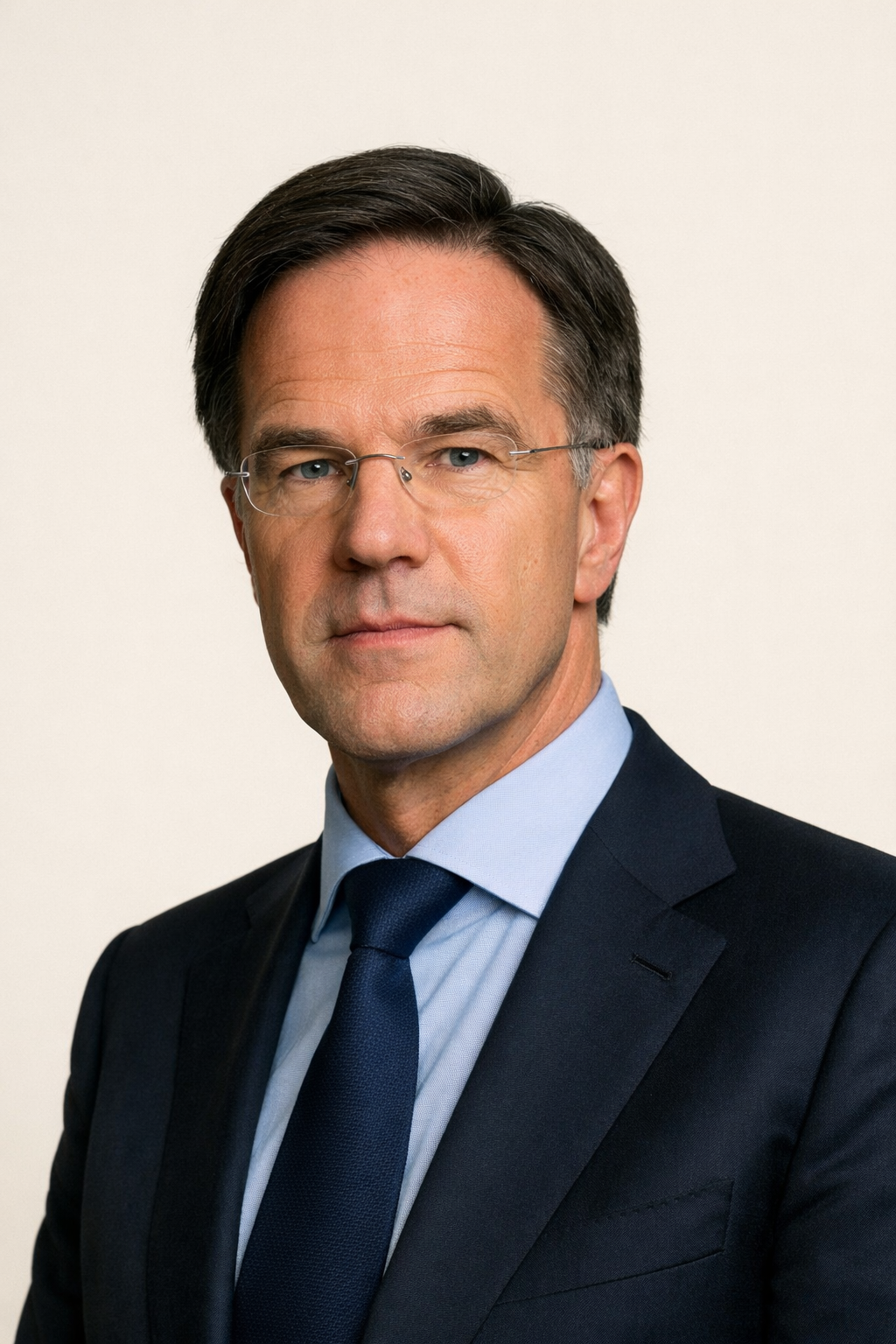
Mark Rutte
Rutte ran the July 7-8 Ankara "NATO 3.0" summit, securing $50B+ in procurements, a €140B Ukraine aid pledge, and a 5%-of-GDP-by-2035 commitment while managing Trump's demands for loyalty, Greenland control, and spending compliance under troop-withdrawal threats.
Mark Rutte ran the July 7-8 Ankara summit, the most consequential NATO gathering in years, and managed its cascading crises in real time. He secured over $50 billion in procurement commitments, a €140 billion Ukraine aid pledge across 31 allies excluding the U.S., and a 5%-of-GDP-by-2035 spending target. He launched a $40 billion counter-drone initiative drawing lessons from Ukraine's battlefield, announced the Saab GlobalEye to replace NATO's E-3 AWACS fleet as the alliance's first non-U.S. surveillance capability, and co-launched with Ursula von der Leyen a transatlantic network to manufacture Abrams tanks, ATACMS missiles, and other U.S. weapons in Europe. He negotiated a Korea-NATO Defense Industry Partnership 2.0 with President Lee, shifting from arms sales to joint R&D and granting Korean firms access to NATO's procurement market.\n\nHis hardest job remains keeping Donald Trump anchored in the alliance. Rutte courted him with a gold-lettered "Trump Trillion" report showing $1.2 trillion in allied spending since 2017 and 195,000 U.S. jobs, and called him "the leader of the free world." But Trump shifted from demanding money to demanding "loyalty," cited allies' refusal to join the Iran war, called NATO a "paper tiger," and threatened to pull all U.S. soldiers from Europe over the Greenland-control dispute. Rutte mediated where he could — steering the Spain crisis to a financial commitment, pointing Greenland to an existing Davos framework deal, and telling Erdoğan to "grab the win" on lifted Türkiye sanctions and signaled F-35 sales.\n\nOn Ukraine, Rutte coordinated the Patriot production-license announcement at Zelenskyy's urging but acknowledged the interceptor supply gap during Russia's July barrage, conceding allies "must continue to ensure Ukraine gets what it needs" even as the Netherlands signaled it had reached its direct-aid limit. He demanded concrete defense-spending plans from allies ahead of the summit, warning "we have ways to do that" for holdouts. He defended U.S. strikes on Iran as "absolutely necessary" after disclosing that 4,000-5,000 U.S. aircraft flew from European bases, drawing "willful complicity" accusations from Tehran. Rutte is steering what he calls "NATO 3.0" — arguing old European dependence on the U.S. "was not sustainable" and setting 3.5% GDP as the realistic European target as the transition shifts Russia responsibility toward Europe.
On their plate
Rutte steered the July 7-8 Ankara summit to a 5%-of-GDP-by-2035 headline pledge, €70B/year in Ukraine aid across 31 allies excluding the U.S., and over $50B in procurements including the $40B Drone Edge counter-drone initiative, the Saab GlobalEye AWACS replacement, and a Patriot production license for Ukraine. He framed the package as proof NATO can deliver at scale.
Rutte deployed a flattery-and-data strategy to keep Trump in the alliance, presenting a gold-lettered "Trump Trillion" report showing $1.2T in allied spending since 2017 and 195,000 U.S. jobs supported. Trump shifted from demanding money to demanding "loyalty," cited allies' refusal to join the Iran war, called NATO a "paper tiger," and threatened to pull all U.S. soldiers from Europe over Greenland. Rutte mediated the Spain crisis and the Greenland standoff where he could.
Rutte coordinated the €140B Ukraine aid pledge and the Patriot production-license announcement, but acknowledged the interceptor supply gap during Russia's July barrage, conceding allies "must continue to ensure Ukraine gets what it needs" even as the Netherlands signaled it had reached its direct-aid limit. Zelenskyy pressed him for fast licensing and immediate interceptor transfers.
Rutte co-launched with von der Leyen a transatlantic weapons-production network to manufacture Abrams, ATACMS, AMRAAM, Stinger, and Barracuda 500M in Europe, noting allies allocated $250B more but production-capacity limits have hindered its use. He also negotiated a Korea-NATO Defense Industry Partnership 2.0 with President Lee, shifting from arms sales to joint R&D and granting Korean firms access to NATO's 15-trillion-won procurement market.
Rutte defended U.S. strikes on Iran as "absolutely necessary" and "totally crucial" responses to ceasefire violations, after disclosing that 4,000-5,000 U.S. aircraft flew from European bases. Iran's spokesman Baghaei accused him of "willful complicity" in an unlawful war of aggression.
Key relationships
Rutte coordinated Ukraine aid and the Patriot production license with Zelenskyy, who pressed for fast licensing to start production in Ukraine "as soon as possible" and pleaded for immediate interceptor transfers.
Rutte and von der Leyen co-launched a transatlantic weapons-production network to manufacture U.S. weapons in Europe and outproduce Russia.
Rutte manages Trump as the dominant force at NATO, using flattery and spending data to keep him in the alliance while absorbing his demands for loyalty, Greenland control, and spending compliance under troop-withdrawal threats.
Rutte nudged Erdoğan to accept the CAATSA sanctions lift and F-35 return, telling him to "grab the win" while pressing that democracy includes media freedom and protest rights.
Rutte received the Czech PM's pledge to hit 2% GDP defense spending next year and 5% by 2035, a 36 billion-crown increase, though Babiš refused extra Ukraine aid beyond the baseline.
Rutte negotiated the Korea-NATO Defense Industry Partnership 2.0 with President Lee, shifting from arms sales to joint R&D and production and granting Korean firms access to NATO's procurement market.
