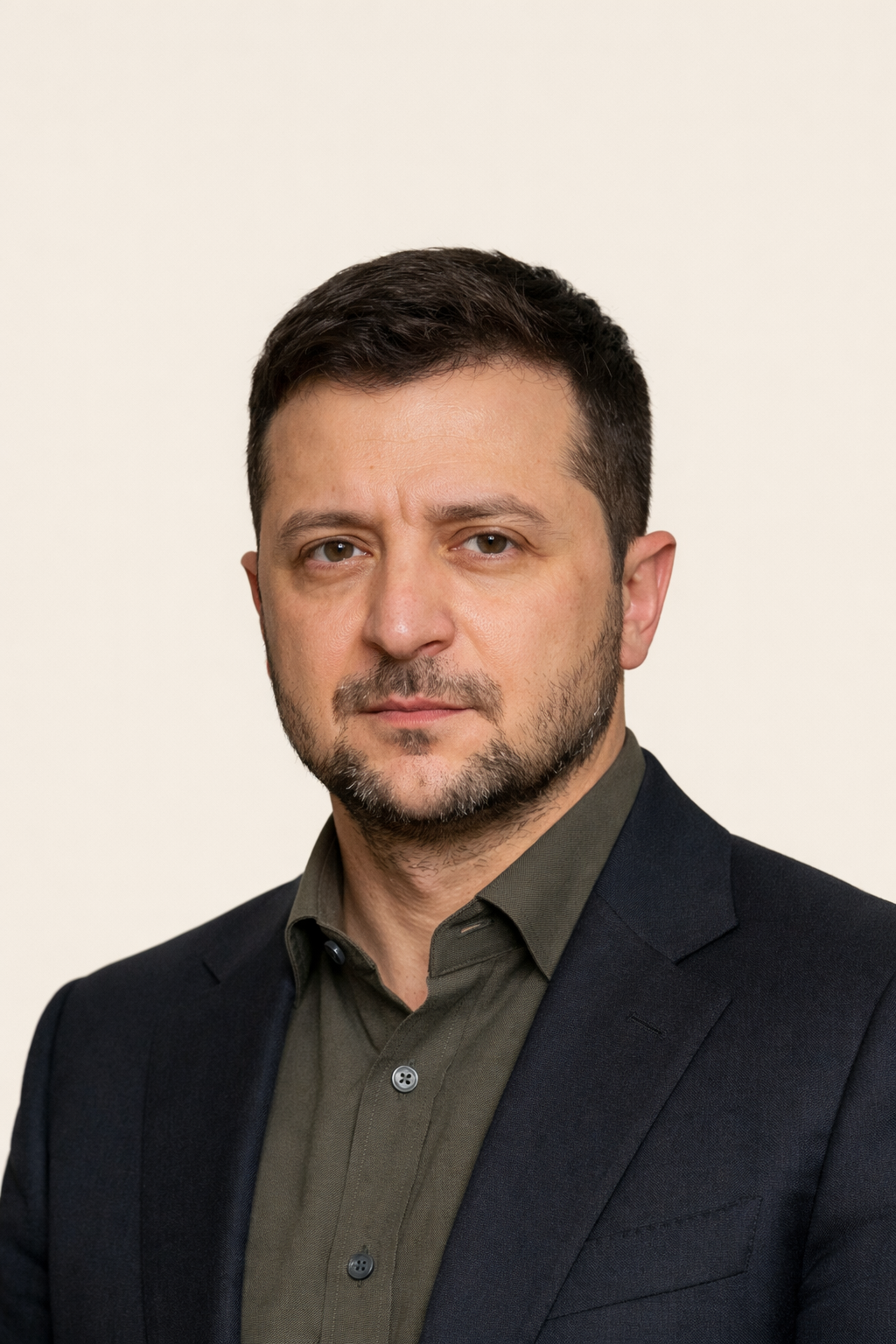
Volodymyr Zelenskyy
Openly feuding with Trump over Russia sanctions waivers, he is touring Brussels for 70 billion euros in extra EU defense funding while pressing an AI drone campaign on Moscow.
Volodymyr Zelenskyy is in open rupture with Donald Trump. Trump waived sanctions on Russian oil to cut U.S. diesel prices, pressed Kyiv to halt refinery strikes and called for a new Ukrainian president, blaming the refinery strikes for rising world oil prices; Washington has stopped sharing early-warning missile data. Zelenskyy calls the waivers "financial rewards for Putin" that only encourage more attacks, brands Putin "a real evil of today," and asks how Trump can be friends with him; Trump says he is no fan and finds Zelenskyy harder to deal with than Putin.
The hedge is Brussels. At the EU summit he put next year's war cost at 155 billion euros and demanded "at least €70 billion more" for defence, weapons and resilience, warning a shortfall could drive a 20-million-person migration crisis. He met NATO chief Mark Rutte on an energy ceasefire and Poland's Donald Tusk on Shahed drone attacks, and is fighting to keep 300 billion euros in frozen Russian assets beyond Moscow's reach.
His pushback runs on drones: in a single week he has sent 2,730 toward the Moscow region, repeatedly closing all four Moscow airports, and he warns that "the safe days in Russia's skies are over," while insisting Ukraine does not target civilian aircraft. Russian strikes on the Kyiv energy ring have cut power to more than a million people at a time, and he has criticized inadequate winter planning.
He still holds a door open to talks on a U.S.-led track, floating a trilateral meeting with Russia at December's Miami G20, though the Kremlin says no bilateral with Putin is on the table. He is also rerouting grain overland after Russian attacks nearly shut Black Sea ports handling 90% of the harvest, and pressing Moscow to unblock famine-hit Oleshky, its population under 2,000.
On their plate
Trump waived sanctions on Russian oil to cut U.S. diesel prices and pressed Kyiv to halt refinery strikes, and Washington has stopped sharing early-warning missile data; Trump then said he is "not a big fan of Zelensky," called for a new Ukrainian president, and blamed the refinery strikes for rising world oil prices. Zelenskyy answers that the waivers are "financial rewards for Putin" that only encourage more attacks, calls Putin "a real evil of today," and defends the refinery strikes as self-defense while praising EU leaders as "real leaders." The rupture reaches the battlefield too: he says Starlink speed restrictions have left Ukraine's interceptor drones non-operational, a link Trump and Elon Musk deny.
At the Brussels summit he told leaders the war will cost 155 billion euros next year and demanded "at least €70 billion more" for defence, weapons and resilience, warning that a shortfall could drive a 20-million-person migration crisis; Ukraine's finance minister puts the defense funding gap at 40 billion euros after Russian strikes on logistics and energy. He met NATO Secretary General Mark Rutte on implementing an energy ceasefire and keeping allied support flowing through the PURL mechanism. He is also fighting to keep 300 billion euros in frozen Russian assets beyond Moscow's reach as EU leaders split over returning them only against reparations or holding them for a final peace deal.
He has sent 2,730 AI-guided drones toward the Moscow region in a single week, repeatedly closing all four Moscow airports, and warns that "the safe days in Russia's skies are over" and that "drone-infested skies are no place for civilian aviation." He insists Ukraine does not target civilian aircraft, even as Trump pins rising world oil prices on the refinery strikes.
Russian Black Sea attacks have nearly shut the ports that handle 90% of Ukraine's harvest, so he is asking Poland, Romania, Slovakia and Hungary for sealed-train transit westward. He has reset ties with Hungarian Prime Minister Peter Magyar, who agreed to let Ukrainian grain cross Hungary in sealed trains bound for Western Europe while refusing to arm Ukraine and pressing the ethnic-Hungarian minority issue. With Poland he says relations have improved under Prime Minister Donald Tusk: "It is very important for us right now to stand together against a single enemy – Russia."
Even amid the rupture he says he is ready to negotiate with Russia on a U.S.-led diplomatic track, floating a U.S.-Ukraine-Russia trilateral meeting at December's G20 in Miami and saying Kyiv is open to any format or venue, including Saudi Arabia or the UAE; Washington has signaled a separate meeting could come as early as next week. He stresses that Trump's oil-sanctions waivers "definitely helps only the Russians" and "certainly does not stop the war," counting on Washington "to put more pressure on Putin, not on us." The Kremlin says no Putin-Zelenskyy bilateral in Miami is on the table.
Key relationships
Trump waived sanctions on Russian oil and pressed Kyiv to halt refinery strikes, Washington stopped sharing early-warning missile data, and Trump then said he is "not a big fan of Zelensky," finds him harder to deal with than Putin, and has called for a new Ukrainian president. Zelenskyy answers that the waivers are "financial rewards for Putin" that only encourage more attacks.
He calls Putin "a real evil of today" and asks how Trump can be friends with him, while pressing Moscow to unblock famine-hit Oleshky and bring Ukrainians home. The Kremlin says no Putin-Zelenskyy meeting is on the table at December's Miami G20.
Zelenskyy says Starlink speed restrictions have left Ukraine's interceptor drones non-operational, and he links White House-ordered Starshield slowdowns to the absence of early warning during Russian strikes on Kharkiv. Musk says any limits on speed or usage are decided by the U.S. military and ultimately the president.
He met Tusk in Brussels to coordinate against escalating Russian Shahed drone attacks, telling him "It is very important that Poland helps us defend against these attacks." He also says relations with Poland have improved under Tusk as Kyiv seeks sealed-train grain transit and stands together against Russia.
They met in Brussels on implementing an energy ceasefire and keeping NATO support flowing to Ukraine through the PURL mechanism.
