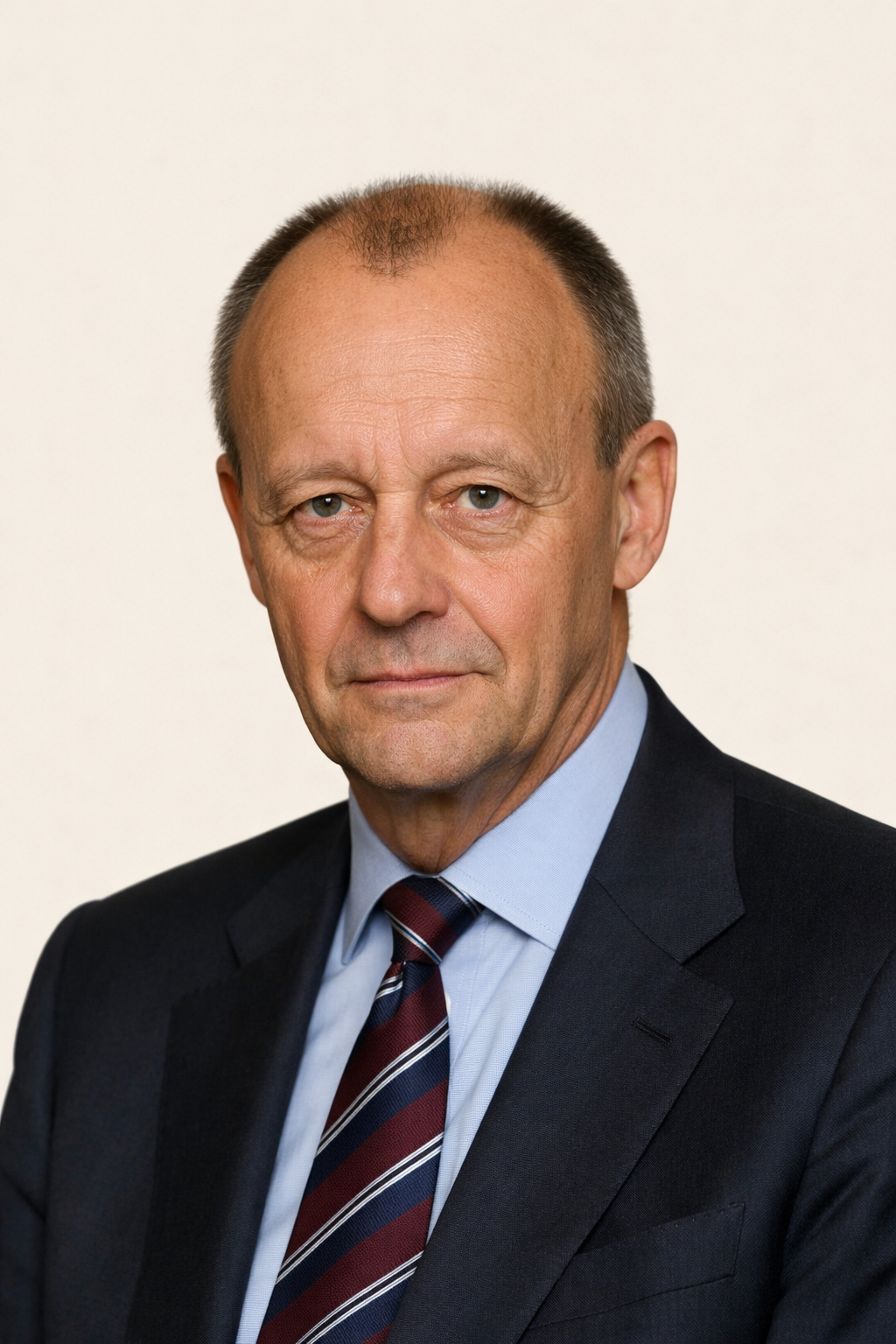
Friedrich Merz
He has vowed to stay in office and not deviate "by a single millimeter" from defending freedom against Russia, after the AfD's state-election wins and a record-low approval rating.
Friedrich Merz has the lowest approval rating of any chancellor in German history, a slide persisting even as the economy shows recovery signs. He called the election results "a disaster": the AfD took a record 44 percent in Saxony-Anhalt, his CDU fell below the 5 percent threshold in Mecklenburg-Western Pomerania, and polls 18 percent nationwide against the AfD's 30. He attacked the AfD's remigration plans as "ethnic cleansing" and has vowed to stay in office, refusing to deviate "by a single millimeter" from defending Germany's freedom against Russia.
He flew unannounced to Kyiv with defense-industry leaders, pledging more than €1.3 billion and signing 15 agreements with Volodymyr Zelenskyy worth over €8.5 billion, and announced weapons with ranges beyond 1,000 kilometers. He is keeping Germany's Russia sanctions in place despite Trump lifting the U.S. fuel ban, called Gerhard Schröder's Putin birthday appearance "downright immoral," and has vowed to stay the aid course even after the Kiel Institute found only €41.7 billion of a reported €100 billion was bilateral.
He cautions that Ireland's €1.62 trillion EU budget is "still a long way" from agreement and must stay affordable for the main financing nations, and with Emmanuel Macron he has urged stronger trade defense against China. His €123.3 billion arms-purchase plan aims to make Germany Europe's strongest conventional army by 2039, with a permanent brigade in Lithuania, Germany's first permanent deployment abroad since 1945. It has drawn "German hegemony" warnings from Poland and France after he scrapped major arms cooperation projects with Paris.
He hosted UK Prime Minister Andy Burnham to ratify the Kensington Treaty, with Burnham inviting Germany into the Tempest fighter program, and pledged to do "anything we can do" to bring the UK closer to Europe. He is meeting ECB succession candidates Klaas Knot and Pablo Hernández de Cos.
On their plate
Merz flew unannounced to Kyiv with a defense-industry delegation, pledging more than €1.3 billion and signing 15 agreements with Volodymyr Zelenskyy worth over €8.5 billion, and announced weapons with ranges beyond 1,000 kilometers. He pressed Kyiv on EU-requested anti-corruption reforms and kept Germany's Russia sanctions in place despite Trump lifting the U.S. fuel ban and calling for Zelenskyy's removal. He has vowed to stay the aid course despite the Kiel Institute's finding that only €41.7 billion of a reported €100 billion qualified as bilateral, even as Germany faces Russian hybrid attacks at home, including drone incidents at Leipzig airport.
The AfD won Saxony-Anhalt with a record 44 percent, putting it in position to form the first far-right regional government in Germany since World War II, while the CDU fell to 17 percent there, below the 5 percent threshold in Mecklenburg-Western Pomerania, and second to The Left in Berlin. The Saxony-Anhalt result is attributed to public discontent over high inflation, rising energy prices and slow growth under Merz's national government. He called the results "a disaster" and "deeply shocking" but vowed to stay in office, and he now has the lowest approval rating of any German chancellor, with a fractious coalition, a car-industry crisis and Trump tariffs weighing on him even as the economy shows recovery signs.
Merz is driving a €123.3 billion arms-purchase plan to make Germany Europe's strongest conventional army by 2039, including a permanent brigade deployment to Lithuania, Germany's first permanent deployment abroad since 1945. The path has opened friction with Poland and France, which have warned of German hegemony, after he scrapped major arms cooperation projects with France in favor of national and U.S. industry and resisted calls for European defense bonds.
Merz is pushing back on Ireland's proposed €1.62 trillion EU budget for 2028-2034, cautioning the bloc is "still a long way from reaching an agreement" and that the budget must be affordable for the nations bearing the main financing burden. He is also running the race for Christine Lagarde's ECB seat, scheduling one-on-one meetings with leading candidates Klaas Knot and Pablo Hernández de Cos while dropping Germany's push for Bundesbank chief Joachim Nagel.
Merz hosted UK Prime Minister Andy Burnham on his first official Berlin visit, ratifying the UK-Germany Kensington Treaty covering defense, science and technology cooperation, and launching a hybrid-threats security partnership and an AI tech corridor. Burnham invited Germany into the Gcap Tempest fighter program, and Merz pledged to do "anything we can do" to bring the UK closer to the European Union as Burnham pushes for closer EU ties.
Key relationships
Merz co-signed a letter with the French president urging the European Commission to implement a new trade diversification instrument and stronger trade defense measures against China, drawing warnings from Beijing that the protectionist "kill-switch" approach would backfire.
Merz met the Ukrainian president in Kyiv, signing 15 agreements worth over €8.5 billion for security cooperation and joint weapons production while pressing his government on EU-requested anti-corruption reforms.
Merz hosted the UK prime minister in Berlin, ratified the Kensington Treaty with him, and backed his push to bring the UK closer to the EU, pledging to do "anything we can do."
Merz is keeping Germany's Russia sanctions in place despite Trump lifting the U.S. fuel ban and calling for Zelenskyy's removal, holding his Ukraine course against Washington's pivot.
The Deutsche Bank chief has publicly pressed Merz's coalition to deliver credible growth-oriented structural reforms, including more flexible labor laws, warning that AfD and Left Party election gains and the slow reform pace are damaging Germany's investment climate.
Merz clashed with the AfD leader in the Bundestag, denouncing her pledge to close borders and implement mass deportations as "ethnic cleansing."
Merz condemned the former chancellor for attending Putin's 74th birthday celebration in Moscow, calling it "downright immoral" and saying Putin bears sole responsibility for the war in Ukraine.
